miLLM: Mechanistic Interpretability LLM Server
An OpenAI-compatible local inference server that attaches pretrained sparse autoencoders to a running model and steers its behavior in real time — now serving whole clusters and discovered circuits, and controllable by AI agents over MCP.
miLLM is a full-featured, OpenAI API–compatible inference server for running open models locally — in the same family as vLLM and Ollama. What sets it apart is what it does while it serves: miLLM can attach pretrained sparse autoencoders (SAEs) to a running model and steer its behavior in real time, turning mechanistic-interpretability features into a live control surface for generation.
What makes it different
- Lock to a model — load and pin a specific model for stable, repeatable serving.
- Attach SAEs to layers — hook one or more pretrained sparse autoencoders onto one or more layers of that model.
- Stage features for steering — line up multiple interpretable features to influence generation during inference.
- Blend influences — when more than one staged feature is set to a non-zero strength, miLLM blends their effects simultaneously, so you can compose behaviors rather than toggle a single knob.
In practice
Because miLLM speaks the OpenAI API, it drops in as the local inference backend for tools you already use — for example Open WebUI. From there you can dynamically shape responses by adjusting the steering strength of selected features, watching the model’s behavior shift live as you turn features up or down.
New: serving circuits and clusters, controllable by agents
miLLM now serves the higher-level structures that miStudio discovers — and exposes live control to AI agents.
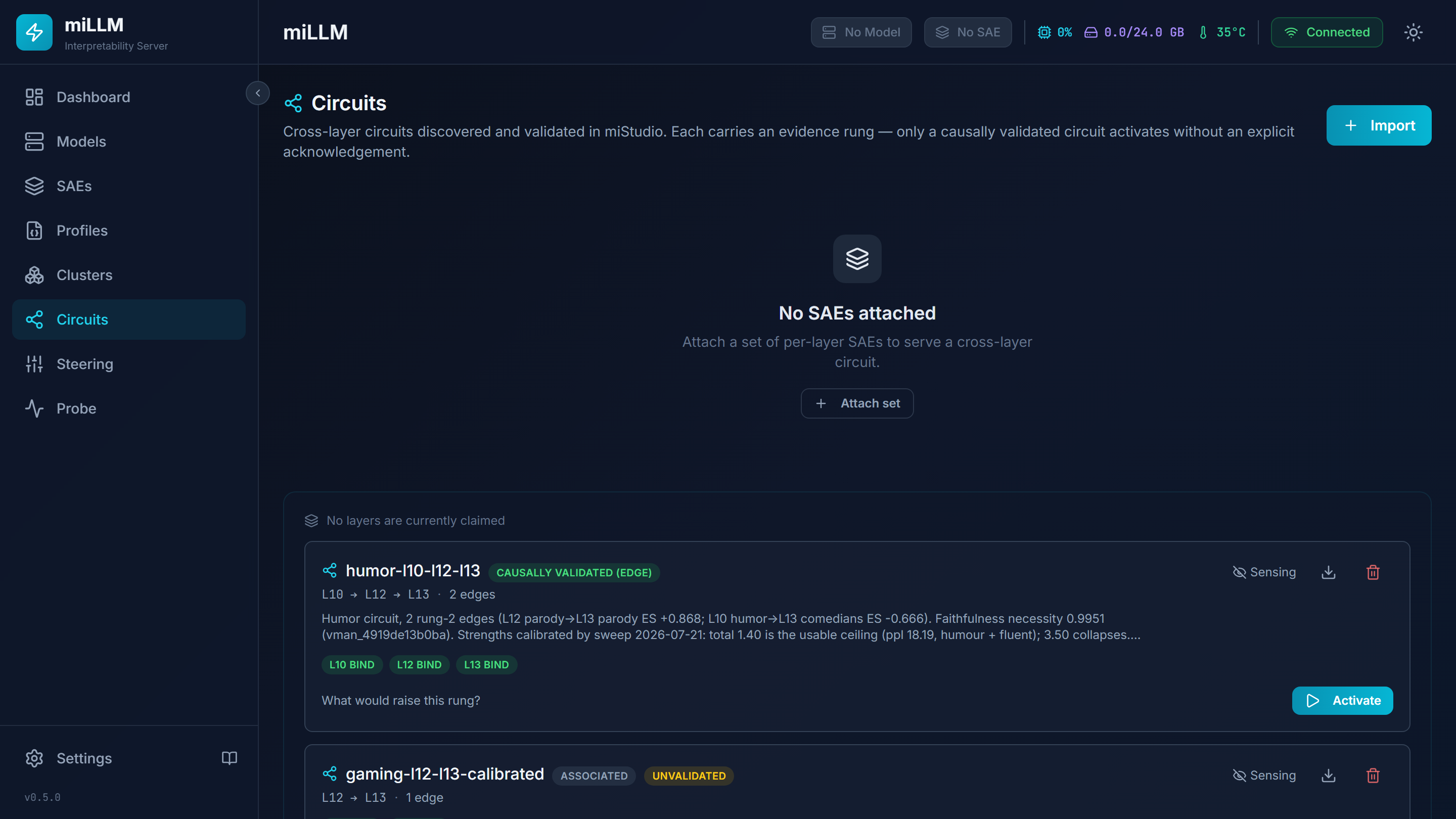
Circuits and clusters at inference
- Circuits — activating a discovered circuit attaches every SAE it references and steers each member through its own layer’s SAE under a single global intensity (λ), with per-layer budgets. If not every SAE can attach, serving degrades gracefully to a per-layer cluster slice rather than failing.
- Clusters — activate a whole group of related features together at a tuned strength (clamped to a safe range), applied per request via the
profileparameter. - Co-activation sensing — miLLM watches forward passes to detect when a circuit’s or cluster’s members actually fire together, signaling that the encoded concept is active.
Agent control via MCP
Because circuits are authored in miStudio, the agent-facing tools live there too: a millm_circuits tool group lets an AI agent inspect what’s deployed, activate and deactivate circuits, adjust steering intensity, and arm event-sensing — all against the running miLLM server. Deliberate safety guardrails apply: unvalidated circuits require explicit acknowledgment, and layer collisions are never silently overridden.
Part of a workflow
miLLM is the serving half of a two-application mechanistic-interpretability ecosystem. Its companion, miStudio, handles the discovery side — training SAEs, discovering and labeling features, and testing and exporting them. miLLM then operationalizes those features at inference time in a production-style local serving environment. Each application stands on its own, but they are considerably more powerful used together: miStudio finds and proves the features; miLLM puts them to work.
Explore miLLM
- Documentation — miLLM Manual
- Overview video — Steer Open WebUI Chat with miLLM
- Source code — github.com/hitsainet/miLLM